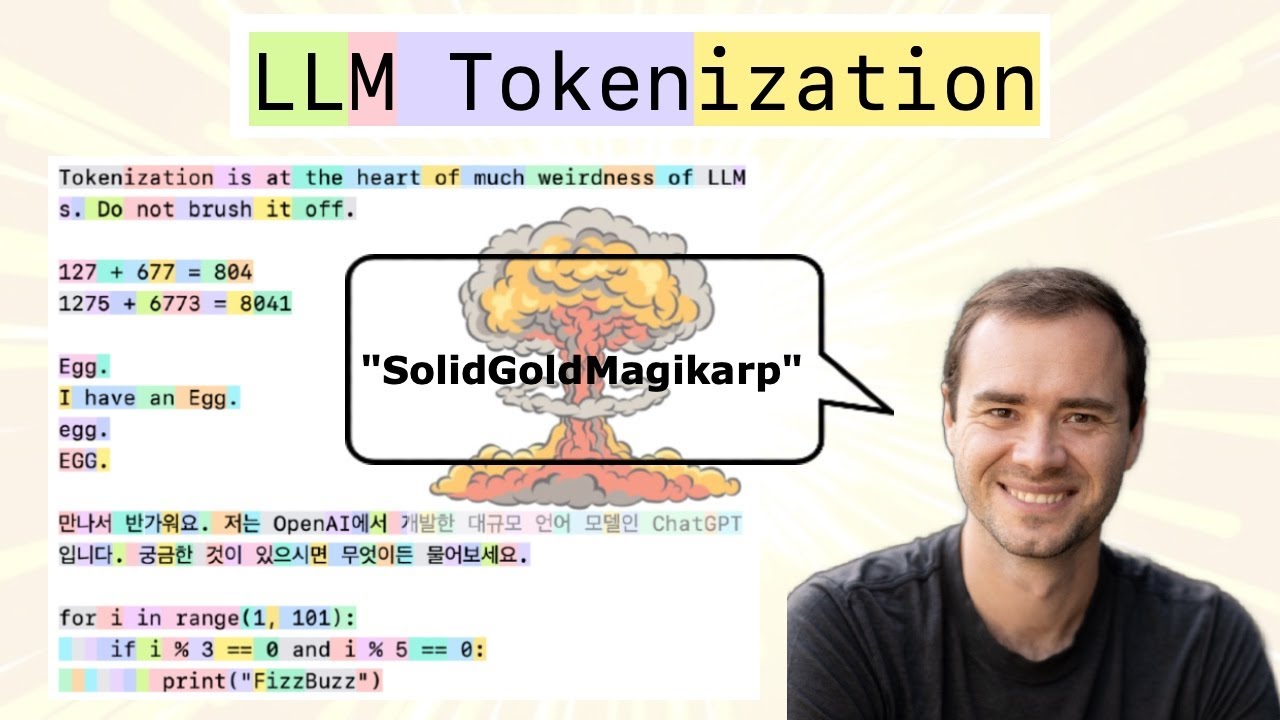
Let's build the GPT Tokenizer
The Tokenizer is a necessary and pervasive component of Large Language Models (LLMs), where it translates between strings and tokens (text chunks). Tokenizers are a completely separate stage of the LLM pipeline: they have their own training sets, training algorithms (Byte Pair Encoding), and after training implement two fundamental functions: encode() from strings to tokens, and decode() back from tokens to strings. In this lecture we build from scratch the Tokenizer used in the GPT series from OpenAI. In the process, we will see that a lot of weird behaviors and problems of LLMs actually trace back to tokenization. We'll go through a number of these issues, discuss why tokenization is at fault, and why someone out there ideally finds a way to delete this stage entirely. Chapters: 00:00:00 intro: Tokenization, GPT-2 paper, tokenization-related issues 00:05:50 tokenization by example in a Web UI (tiktokenizer) 00:14:56 strings in Python, Unicode code points 00:18:15 Unicode byte encodings, ASCII, UTF-8, UTF-16, UTF-32 00:22:47 daydreaming: deleting tokenization 00:23:50 Byte Pair Encoding (BPE) algorithm walkthrough 00:27:02 starting the implementation 00:28:35 counting consecutive pairs, finding most common pair 00:30:36 merging the most common pair 00:34:58 training the tokenizer: adding the while loop, compression ratio 00:39:20 tokenizer/LLM diagram: it is a completely separate stage 00:42:47 decoding tokens to strings 00:48:21 encoding strings to tokens 00:57:36 regex patterns to force splits across categories 01:11:38 tiktoken library intro, differences between GPT-2/GPT-4 regex 01:14:59 GPT-2 encoder.py released by OpenAI walkthrough 01:18:26 special tokens, tiktoken handling of, GPT-2/GPT-4 differences 01:25:28 minbpe exercise time! write your own GPT-4 tokenizer 01:28:42 sentencepiece library intro, used to train Llama 2 vocabulary 01:43:27 how to set vocabulary set? revisiting gpt.py transformer 01:48:11 training new tokens, example of prompt compression 01:49:58 multimodal [image, video, audio] tokenization with vector quantization 01:51:41 revisiting and explaining the quirks of LLM tokenization 02:10:20 final recommendations 02:12:50 ??? :) Exercises: - Advised flow: reference this document and try to implement the steps before I give away the partial solutions in the video. The full solutions if you're getting stuck are in the minbpe code https://github.com/karpathy/minbpe/blob/master/exercise.md Links: - Google colab for the video: https://colab.research.google.com/drive/1y0KnCFZvGVf_odSfcNAws6kcDD7HsI0L?usp=sharing - GitHub repo for the video: minBPE https://github.com/karpathy/minbpe - Playlist of the whole Zero to Hero series so far: https://www.youtube.com/watch?v=VMj-3S1tku0&list=PLAqhIrjkxbuWI23v9cThsA9GvCAUhRvKZ - our Discord channel: https://discord.gg/3zy8kqD9Cp - my Twitter: https://twitter.com/karpathy Supplementary links: - tiktokenizer https://tiktokenizer.vercel.app - tiktoken from OpenAI: https://github.com/openai/tiktoken - sentencepiece from Google https://github.com/google/sentencepiece
 YouTube